

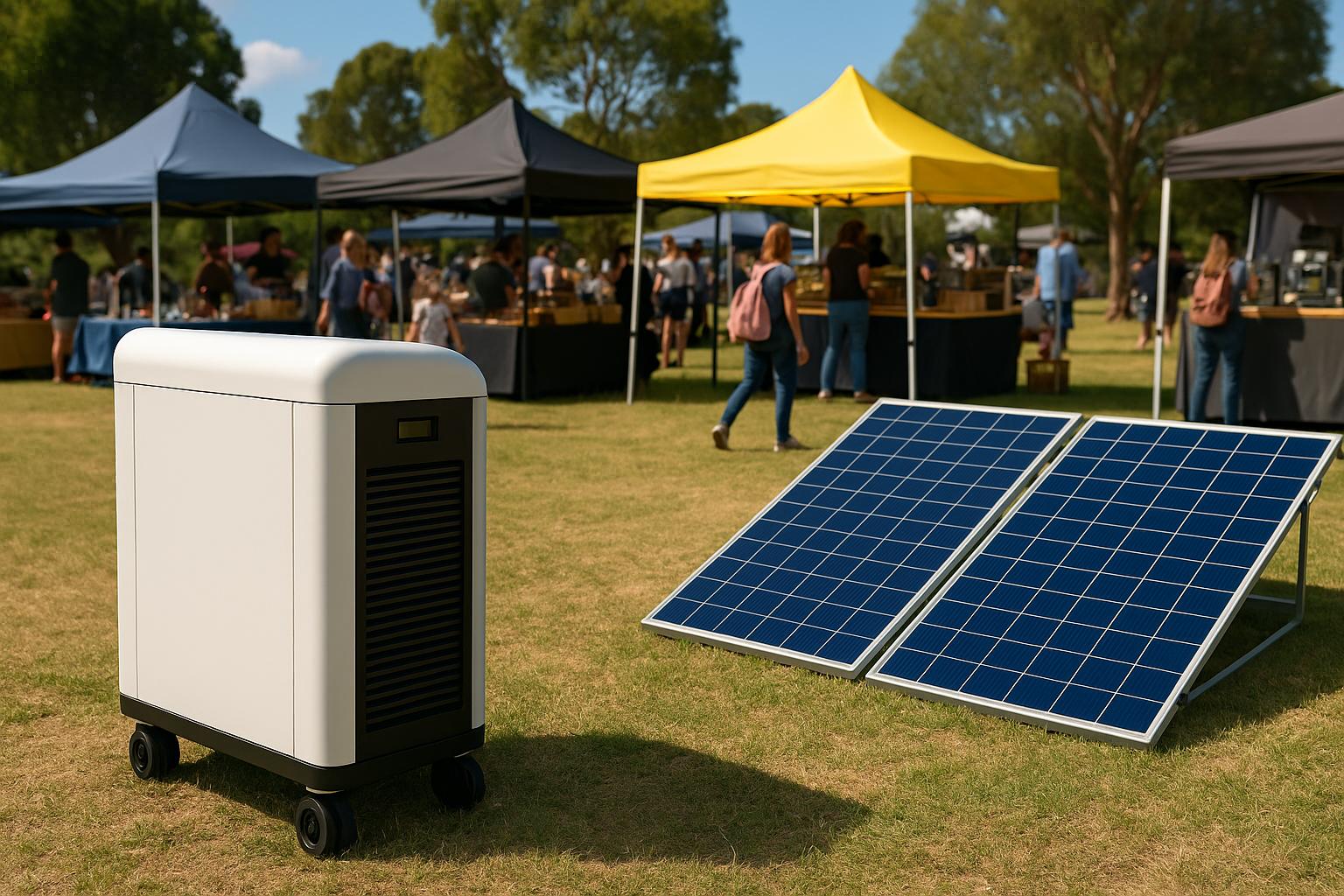
At a weekend market in Cranbourne, you’d be forgiven for thinking something was missing. No rumble of generators and no acrid diesel fumes. Just local stallholders, kids with face paint, a coffee van buzzing. Power, it turns out, doesn’t need to pollute.
That’s the quiet revolution unfolding in the City of Casey, where a year-long trial called the Climate Action Living Lab is turning everyday community events into proving grounds for cleaner, smarter climate solutions. This is climate action at eye level. It’s accessible, practical, and powered by locals.
Launched in early 2025, the Living Lab is more than just a council initiative, it’s a civic experiment in real-world problem-solving. From mobile battery units replacing petrol generators, to data-backed energy trials that rethink how neighbourhoods power up. Casey isn’t just setting targets, it’s road-testing the future.
What Is the Living Lab?
The City of Casey’s Climate Action Living Lab is a 12-month experiment in community-driven climate innovation. Launched in February 2025 and running through early 2026, the program invites local partners to trial bold ideas that could help the municipality reduce emissions.
It’s not a think tank. It’s a do tank.
Developed in collaboration with six external organisations — including clean-energy startup Equoia, the Monash Climate Change Communication Hub, and Federation University, the Living Lab sets out to answer a simple but crucial question: What happens when climate action meets local life?
The approach is hands-on, co-designed, and grounded in measurable outcomes. It’s about putting ideas to the test not just in spreadsheets or PowerPoints.
Power Droids: A Quiet Revolution in Community Energy
Perhaps the most eye-catching initiative so far is Power Droids. Developed by Equoia, these portable battery-powered units are designed to replace noisy, emissions-heavy diesel generators traditionally used at community events.
Unlike their fossil-fuel cousins, Power Droids emit no exhaust, produce almost no noise and are recharged using solar power. The same technology increasingly powering homes and small businesses across Victoria thanks to local solar system installers, such as Trione Energy. At Casey’s weekend markets, sports events, and festivals, they’ve quietly begun powering coffee vans, PA systems, and lighting..
Why the Living Lab Matters
What sets Casey’s approach apart is its willingness to treat the community as collaborators and not just recipients. Each project in the Living Lab is designed with local input. And each trial includes mechanisms for feedback, monitoring, and adjustment.
In a landscape where government climate targets can often feel vague or decades away, Casey’s program brings urgency back into the frame.
It’s also smart local governance. Rather than investing prematurely in untested technologies, the Council is using its own public spaces and programs as a low-risk testing ground with the potential to expand whatever works.
If the Power Droids prove successful, they could become a permanent fixture at Casey events, reducing the city’s diesel dependence and demonstrating a scalable solution for other councils across Victoria and beyond.
Early Feedback and Lessons So Far
The reception so far has been promising. Community members have praised the absence of fumes and noise, and event organisers appreciate the ease of setup and reliability.
From a council perspective, the early data is encouraging. Power Droids have proven capable of powering small-to-medium events with ease, offering not just environmental benefits but also improved public experience.
Challenges remain; from recharge logistics to cost per unit. But the purpose of the Living Lab is not to deliver perfect outcomes, it’s to learn in public, fail fast if necessary and evolve faster.
What’s Next?
The Living Lab continues through early 2026, with new event trials, community surveys, and technical reviews planned in the months ahead. Council staff will assess the scalability of each trial based on performance data, user feedback, and potential cost-benefit to ratepayers.
If successful, the program could lead to a formal adoption of Power Droids across Casey events, expansion into community group leasing schemes, or integration with emergency preparedness systems.
What’s clear is this: the Living Lab isn’t a gimmick. It’s a genuine attempt to democratise climate action and build something that lives in the real world, not just the policy paper.
And so far, that “something” looks like families gathering at diesel-free events, kids learning from battery-powered school projects, and a council quietly proving that local climate action doesn’t need to shout. It just needs to work.
The City of Casey may not have all the answers. But they’re not waiting for someone else to find them. They’re out there in the field, at the park, and at the market experimenting, listening, learning.
And in 2025, that might just be the most hopeful thing of all.